

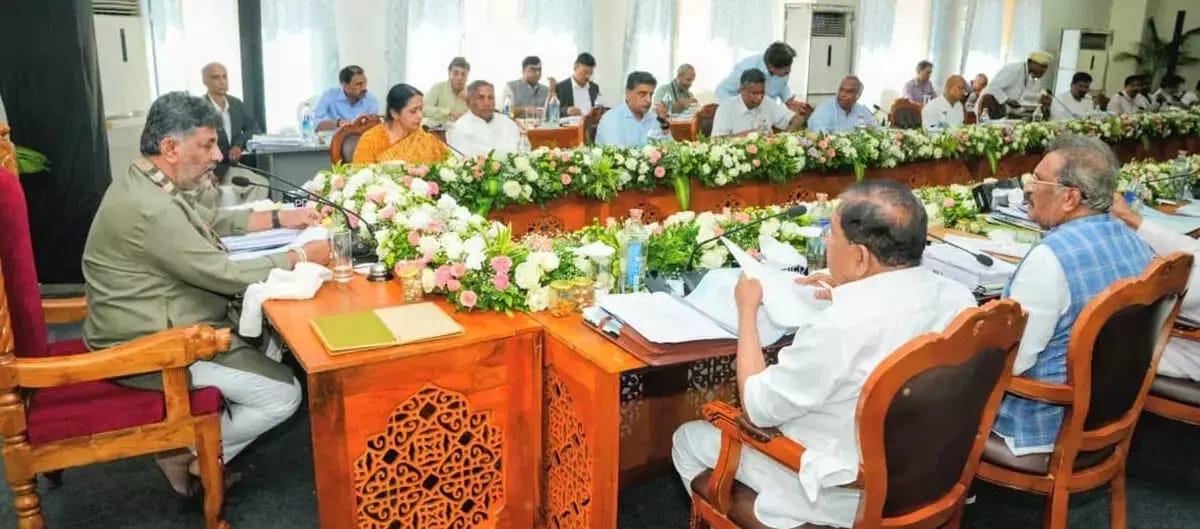
Bhatkal: When Karnataka Chief Minister D K Shivakumar chose Mangaluru for the first Cabinet meeting of his government outside Bengaluru, the decision carried significance beyond the administrative announcements made at the meeting. The coastal districts of Karnataka have for decades been among the strongest political territories of the BJP. Taking the Cabinet to Mangaluru, therefore, can be viewed not merely as an exercise in decentralised governance but as an attempt by the Congress government to enter the BJP’s political stronghold and build a new political narrative ahead of the 2028 Assembly elections.
The political challenge before Shivakumar is substantial. In the 2023 Assembly elections, the BJP won 11 of the 13 seats in Dakshina Kannada and Udupi, while the Congress won only two. The BJP secured all five seats in Udupi and six of the eight seats in Dakshina Kannada.
That electoral arithmetic explains why Mangaluru matters. If the Congress wants to expand its political footprint in Karnataka, the coastal belt cannot be treated as a peripheral region. The question is whether development, regional identity and a direct political engagement with coastal communities can help the Congress challenge a political structure that the BJP has built over several election cycles.
The September 18 Cabinet meeting appears to be an important part of that effort. The government approved proposals worth around Rs 32,611 crore, including roughly Rs 16,000 crore for rural development and another Rs 16,000 crore for Mangaluru, Udupi and the coastal region. Tourism, fisheries, urban development, infrastructure and the blue economy figured prominently in the decisions. A new tourism policy for the coastal and Malnad regions was also announced.
But the political significance of the meeting lies less in the size of the package than in the decision to take the state government to a region where the Congress has struggled electorally. Before the meeting, elected representatives, trade bodies, cultural organisations and community groups had placed a long list of demands before the government, including employment generation, tourism, industrialisation, coastal erosion and recognition for Tulu.
Development as a Political Instrument
For the Congress, the coastal belt presents a different political challenge from many other parts of Karnataka. Developmental indicators alone do not determine electoral behaviour here. Questions of identity, religion, language, culture and regional sentiment have played a significant role in shaping politics.
Shivakumar appears to be testing whether the political conversation can be widened from identity politics to development and regional aspirations.
The government’s decision on Tulu is significant in this context. Tulu has been given the status of the state’s second additional administrative language in Dakshina Kannada and Udupi, rather than being declared Karnataka’s second official language statewide. The decision addresses a longstanding demand of Tulu-speaking communities and gives the language a defined administrative role in the two coastal districts.
The language decision also raises an interesting question about Karnataka’s wider linguistic landscape. According to the 2011 Census, Urdu is the state’s second-largest mother tongue after Kannada, yet it does not enjoy the status of a second official language across Karnataka. The Tulu decision, therefore, demonstrates how regional linguistic identity can become an important part of political and administrative policy.
Whether this move will translate into electoral support is impossible to establish at this stage. But politically, it allows the Congress government to present itself as responsive to a longstanding regional demand in an area where it needs to expand its presence.
The BJP’s Coastal Fortress
The BJP, meanwhile, is unlikely to view the Mangaluru initiative simply as a development exercise. The party has already questioned the financial basis and implementation prospects of the Cabinet announcements. Opposition leader R Ashoka argued that the announcements could remain on paper, while BJP Legislative Council Chief Whip N Ravi Kumar questioned the source of funding for the Rs 32,611-crore package.
At the same time, BJP leaders have interpreted Shivakumar’s presence in coastal Karnataka through a political lens. A senior BJP leader told PTI that the Chief Minister was attempting to use “soft Hindutva” to make a dent in the BJP’s coastal vote base. That is the BJP’s political interpretation, rather than an officially stated objective of the Cabinet meeting.
The Congress, for its part, is putting the emphasis on development. Home Minister Priyank Kharge has argued that the BJP had turned coastal Karnataka into a “laboratory for communalism” while the Congress government was seeking to turn it into a “laboratory for development.” This is also a political claim from the ruling party and should be understood in that context.
The contrasting narratives reveal the real contest taking shape in the coastal belt: the BJP is seeking to retain an established political base, while the Congress is attempting to change the terms of political engagement.
The 2028 Question
There is still considerable time before the next Assembly election. It would therefore be premature to assume that the Mangaluru Cabinet meeting will alter the electoral map. The immediate test is implementation.
The government has promised major investments in tourism, fisheries, infrastructure and other sectors. If these announcements translate into visible projects, employment opportunities and improvements in public infrastructure, they could provide the Congress with a development-based political narrative in a region where its electoral presence remains limited.
If implementation falls short, the BJP will have an obvious political counterargument. BJP leaders have already begun questioning whether the announcements will actually reach the coast.
This makes the Mangaluru Cabinet meeting more than a one-day political spectacle. It is an early indication of how Shivakumar’s Congress intends to approach a region that has remained difficult territory for the party.
The BJP has its established organisational network and electoral base. The Congress now appears to be testing a different route: take the government to the coast, respond to regional demands, emphasise development, engage with linguistic and cultural identity, and attempt to create a political constituency beyond the traditional Congress vote.
Whether that strategy can substantially change the political balance remains an open question. But one thing is clear: with the 2028 Assembly elections on the horizon, the political battle for coastal Karnataka has begun much earlier than the election campaign itself.