

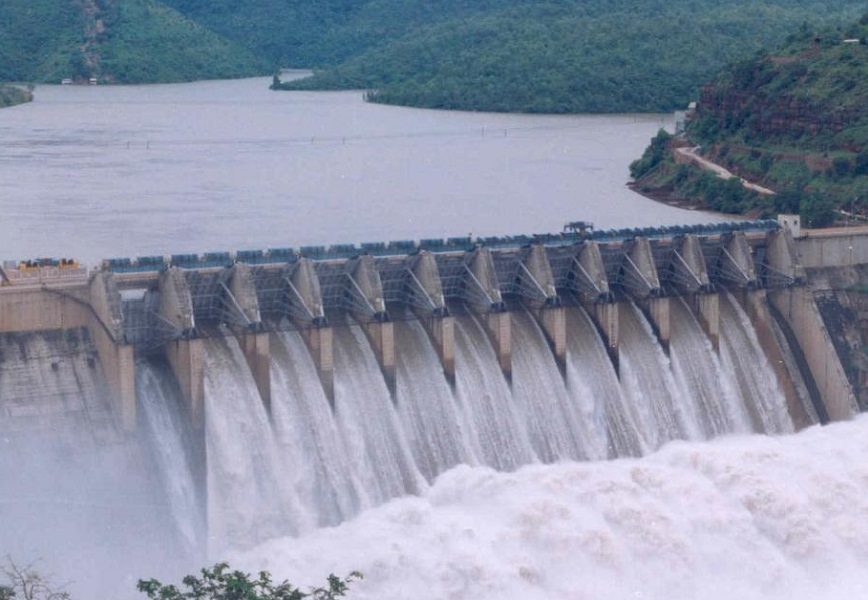
Bhatkal: Expectations that the Linganamakki reservoir would fill up during July have been dashed as inadequate rainfall across its catchment area has left one of Karnataka's most important reservoirs with critically low water levels. The situation has raised serious concerns over hydropower generation, drinking water availability and the possibility of a severe drought in the coming months.
Located on the Sharavathi River in Sagar taluk of Shivamogga district, about 110 km from Bhatkal, the Linganamakki reservoir is Karnataka's largest hydroelectric reservoir and the main reservoir feeding the Sharavathi Hydroelectric Project, making it one of the state's most important sources of electricity.
According to the latest data, the water level in the Linganamakki reservoir stood at 1,773.15 feet on Tuesday, compared to 1,810.50 feet on the corresponding day last year—a decline of 37.35 feet. While the reservoir had reached 82.12 percent of its storage capacity by this time last year, it is only 29.03 percent full this year.
Under normal monsoon conditions, the reservoir level crosses 1,815 feet by the last week of July, prompting the Karnataka Power Corporation Limited (KPCL) to issue its second notification for releasing excess water. In many previous years, the reservoir had filled completely by the end of July or the first week of August. On a few occasions, the water level even touched 1,819 feet before regulated discharge began. This year, however, the reservoir, which is usually brimming with water during this period, remains far below normal.
According to the analysis, the alarming situation is primarily the result of poor rainfall across the reservoir's catchment area, where rain-bearing clouds have remained scarce throughout the season. The analysis warns that unless rainfall improves significantly or measures such as cloud seeding are undertaken, Karnataka could face not only a power shortage but also a serious drinking water crisis.
The analysis notes that the shortage of water has also cast uncertainty over electricity generation. Increasing dependence on thermal power stations may not offer an immediate solution, as thermal plants in Raichur and Ballari are themselves facing water shortages required for cooling operations due to poor rainfall in those regions. Solar power remains limited because it cannot supply electricity at night, while proposals for new nuclear power plants continue to face opposition from environmental groups. Purchasing power from private producers is another option, but it is unlikely to be sufficient to meet the state's overall demand and would come at a much higher cost.
The analysis says that implementing pumped-storage hydropower projects could provide a long-term solution by allowing water to be reused for electricity generation. Such projects could help ensure a more stable power supply even if rainfall remains below normal for one or two consecutive years.
Hydropower projects currently supply around 30 to 40 percent of Karnataka's electricity at relatively low cost while also supporting irrigation. However, catchment areas feeding most of these projects are facing conditions similar to those at Linganamakki. The analysis notes that continuing hydropower generation with the limited water available could compromise drinking water supplies, forcing hydroelectric power generation to remain suspended for the time being.
Describing the situation as extremely serious, the analysis says that even if August receives exceptionally heavy rainfall, it may not be enough to offset the existing storage deficit. It adds that KPCL is facing one of the most uncertain situations in its history and warns that the prevailing conditions could be an early indication of a severe drought if the rainfall deficit persists.