

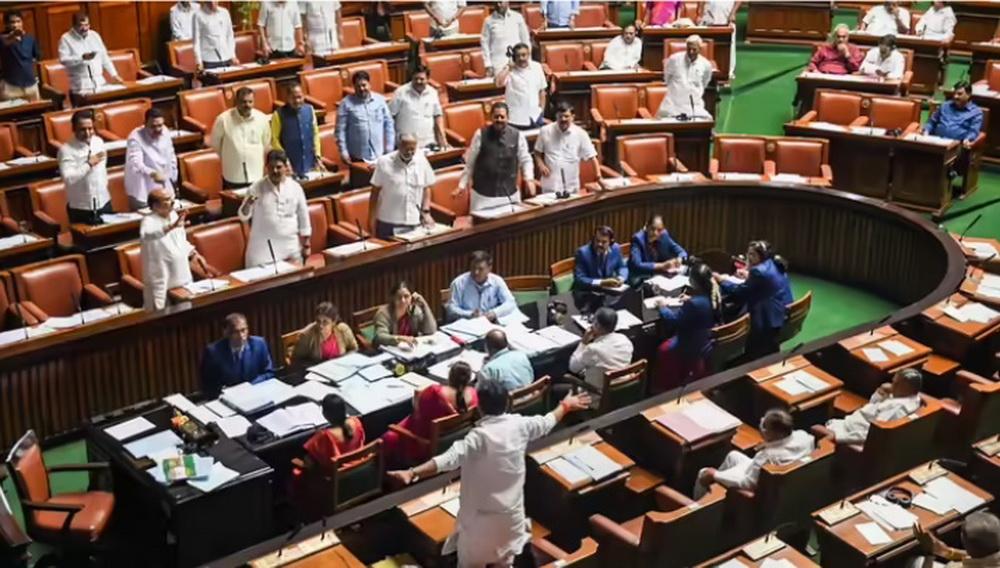
Belagavi: The Karnataka government on Wednesday introduced the Karnataka Hate Speech and Hate Crimes (Prevention and Control) Bill, 2025 in the State Assembly, prompting a sharp and noisy protest from BJP legislators. The Bill, cleared by the Cabinet earlier this month, was tabled by Home Minister G. Parameshwara after Law Minister H.K. Patil initiated the process.
As Speaker U.T. Khader called for a voice vote to allow the tabling of the Bill, BJP MLAs shouted in opposition and demanded that the matter be sent to a select committee. Despite V. Sunil Kumar pressing for a division of votes, the Speaker permitted the Bill’s introduction, following which the uproar intensified and proceedings were briefly adjourned.
The Bill seeks to curb hate speech and hate-motivated crimes by strengthening the legal framework that deals with communal tensions in the state. It defines hate speech as any spoken or written expression, sign, visual representation or electronic communication intended to incite hatred, enmity or harm against an individual or group based on religion, caste, community, race, gender, sexual orientation, place of birth, residence, language, tribe or disability. Acts that promote, propagate or attempt to instigate such speech will be treated as hate crimes.
For a first offence, the Bill prescribes one to seven years of imprisonment and a fine of ₹50,000. Repeat offences may draw a jail term of two to ten years along with a fine of ₹1,00,000. All offences under the proposed law will be cognisable and non-bailable. Courts may also award compensation to victims depending on the gravity of the offence. The Bill further states that if an institution is found guilty, individuals responsible for its operations at the time of the offence will be assumed liable unless they can prove that the act occurred without their knowledge or that they exercised all due diligence to prevent it.
In addition to defining offences, the Bill grants preventive powers to authorities. Executive magistrates, special executive magistrates and deputy superintendents of police will be empowered to take preventive action if they believe that an individual or group is likely to commit an offence under the legislation. A designated officer appointed by the state government will also be authorised to direct service providers, intermediaries, platforms or entities to block or remove hate-crime content from their domains, including digital platforms.
Home Minister Parameshwara rejected allegations that the Bill targets the Opposition, particularly the BJP. “This is not meant to target the BJP. We will not be in power permanently. Governments change. Whoever comes to power, the law will remain in place,” he said, adding that the Bill does not mention any political party and is being introduced only because of current societal needs. “Why should we target the BJP? This strengthens existing laws,” he said.
During the heated House session, H.K. Patil countered the Opposition’s objections, asking why the BJP was “so anxious” about the legislation. “The Constitution already prohibits hate speech. We are only implementing those principles. If they have done no wrong, why fear this Bill?” he questioned. Patil added that only those who benefit from disrupting social harmony would oppose a law aimed at protecting peace across communities.
Congress MLA Priyank Kharge also criticised the BJP’s resistance, asking whom the Opposition was “trying to protect”. He argued that the Bill was intended for public safety, not political targeting.
BJP, however, maintained that the government was attempting to silence dissent and weaponise the law against Hindutva-aligned groups, especially in the communally sensitive coastal belt. Leader of Opposition R. Ashoka described the Bill as a conspiracy to suppress political critics under the guise of regulation. BJP members claim that the provisions could be misused to target their supporters and activists.
The state government has pointed to recent retaliatory communal killings and growing tensions in the Mangaluru region as justification for the new law. It has already formed a specialised force to monitor sensitive areas of coastal Karnataka and deployed dedicated teams to track online content that could incite violence.
Alongside the hate speech Bill, the government tabled several other legislations, including amendments to the Drugs and Cosmetics Act granting the state powers similar to the Central Drugs Laboratory and imposing stricter penalties for adulteration, along with Bills related to universities, religious institutions, labour welfare, regional development boards and rent regulations.