

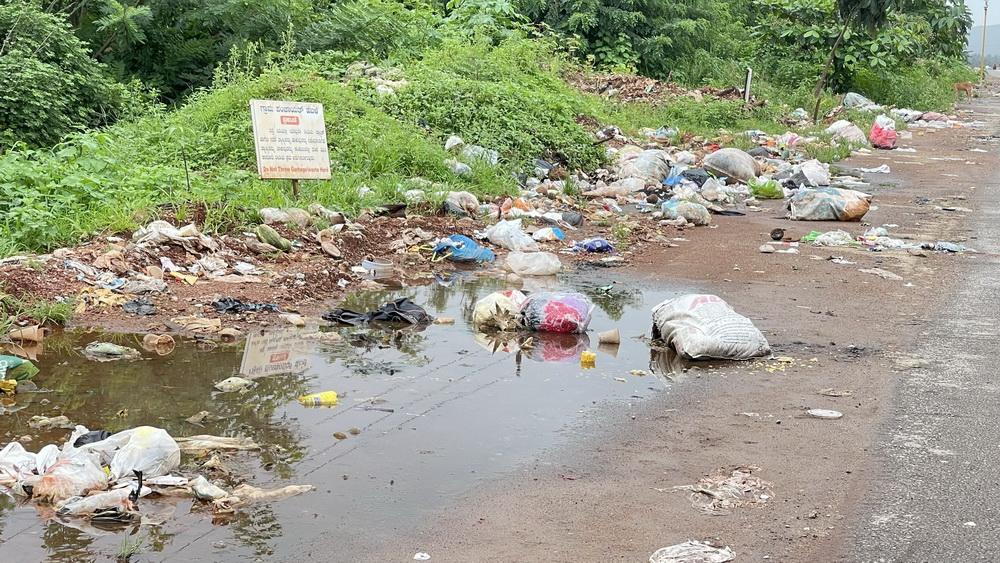
Bhatkal: Once celebrated as a town of refined residents known for their neat attire and dignified lifestyle, Bhatkal is now increasingly identified with the stench of rotting garbage piling up along its streets and corners. A place once associated with cleanliness and order now struggles under the weight of filth, civic neglect, and failing infrastructure.
Despite repeated efforts by both government and private entities to modernize the city—through projects such as the expansion of National Highway 66, state road upgrades, and the implementation of underground drainage systems—the results have been marred by poor execution and chronic delays.
The NH-66 expansion, in particular, has moved at a painfully slow pace for years, leaving surrounding areas in disrepair and causing significant inconvenience to commuters. Concurrently, ongoing UGD works have led to unregulated digging across the town, turning roads into hazards and contaminating once-reliable freshwater wells—many of which now resemble open sewer chambers.
Exacerbating these issues is the growing problem of uncollected garbage, now a daily nuisance across multiple locations. Persistent monsoon rains are accelerating the decay of these waste piles, intensifying the foul odor and severely impacting the quality of life for nearby residents. Adding to the chaos, packs of stray dogs rummage through these dumps, raising public safety concerns.
One of the most alarming challenges facing Bhatkal is the unchecked and indiscriminate dumping of waste along roadsides, street corners, and particularly near the National Highway. Residents from neighboring areas are reportedly discarding their garbage under cover of darkness, leaving locals helpless—confined to voicing complaints and blaming civic bodies, but with little resolution in sight.
To its credit, the Bhatkal Town Municipality does operate a door-to-door waste collection system in parts of the city. However, there is an urgent need to enhance its efficiency, coverage, and enforcement to make it genuinely effective.
A significant part of the problem stems from segments of the population that remain indifferent or unaware of basic public hygiene. Despite ongoing awareness campaigns, some residents continue to dispose of household waste into drains or vacant lots. Others, frustrated with inconsistent garbage collection, resort to dumping their waste in nearby areas instead of using designated municipal services.
More troubling is the conduct of seemingly educated and well-dressed individuals who are often seen tossing waste from their two-wheelers into deserted spots. This disturbing disconnect between external sophistication and civic responsibility points to a deeper cultural malaise.
In certain areas, municipal authorities, local panchayats, and socially active youth groups have made commendable efforts to clean these illegal dumping sites, even installing signs that read: “Do not litter,” “CCTV surveillance in place,” and “Violators will be fined.” However, such measures are often short-lived. Within days, garbage dumping resumes, mocking attempts at order and exposing the limits of voluntary discipline.
Ironically, despite the presence of a designated waste collection and dumping yard on Sagar Road, waste continues to accumulate along nearby thoroughfares—including areas like Hanifabad Cross, Poorverga, and sections near Venkatapur. These unofficial dumping grounds have become breeding zones not just for stray animals, but increasingly for wild boars—posing an alarming threat to public safety.
Meanwhile, the incomplete and dilapidated stretches of NH-66 already pose challenges for commuters. The addition of roadside garbage heaps has made several sections nearly impassable. The monsoon has only made matters worse, enlarging potholes and road cracks, thereby increasing the risk of accidents and fatalities.
In light of the current scenario, one must ask: can Bhatkal still be considered a city of clean, conscious, and cultured citizens?
What is urgently required is a two-pronged approach. Firstly, the municipal and panchayat authorities must overhaul the waste management system, address its existing shortcomings, and ensure timely and efficient garbage removal. Secondly, public dumping hotspots must be strictly monitored—not only with CCTV cameras and warning signs, but through real-time enforcement. Offenders must be identified and penalized without hesitation.
Without strong, sustained action, expecting meaningful change would be nothing short of delusional.